






Molecular hydrogen, endurance and fatigue
A pilot study with elite soccer players asked whether a week of hydrogen-rich water changes how muscles cope with hard exercise.
- Study typeHuman pilot trial
- Who took part10 elite athletes
- How long1 week per phase
The short version
- 01Ten male soccer players drank hydrogen-rich water or placebo water for a week, then swapped, without knowing which was which.
- 02After hard cycling, blood lactate rose on placebo water but not on hydrogen water.
- 03Muscle strength dropped early on placebo during repeated leg extensions, but not on hydrogen water.
Why exercise scientists are interested
Hard training produces reactive oxygen species. That is part of how the body adapts and gets fitter, but it is also linked to fatigue and muscle damage after intense sessions.
Because hydrogen has been studied as a selective antioxidant, sports scientists wanted to know whether drinking it could change how muscles hold up under heavy work.
What the researchers did
Ten male soccer players, about 21 years old, took part in a double-blind crossover trial. Each drank hydrogen-rich water for one week and placebo water for another, so every athlete acted as his own comparison.
After each week they cycled for 30 minutes at 75% of their maximum oxygen uptake, then did 100 maximal knee extensions on a machine that measures muscle force. The team tracked blood lactate, muscle strength and markers of oxidative stress and muscle damage.
The study
Medical Gas Research 2:12 · 2012
Aoki K, Nakao A, Adachi T, Matsui Y, Miyakawa S. Pilot study: effects of drinking hydrogen-rich water on muscle fatigue caused by acute exercise in elite athletes.
Read the original paperDOI 10.1186/2045-9912-2-12
What they found
On placebo water, blood lactate rose during the heavy exercise. On hydrogen water it did not.
Peak muscle force dropped during the repeated knee extensions on placebo, a sign of fatigue, but did not drop in the early phase on hydrogen water. The authors concluded that hydrogen-rich water before exercise may be a suitable way for athletes to hydrate.
10
male soccer players, about 21 years old
Week 1
Half: hydrogen water
Half: placebo water
swap
Week 2
Half: placebo water
Half: hydrogen water
After each week
30 min cycling at 75% VO₂max, then 100 maximal knee extensions
Measured
Blood lactate, peak muscle force, oxidative-stress and muscle-damage markers
Every athlete acted as his own comparison: one week on hydrogen water, one week on placebo.
What other studies say
The picture across sports research is mixed. A 2019 randomised trial reported better endurance and less perceived fatigue with hydrogen water, while other trials have found no clear effect on performance. A 2024 systematic review called the early results encouraging but asked for larger, more rigorous studies.
What this study doesn’t show
- It was a pilot with just ten young men, all elite soccer players.
- It measured one type of exercise session, not long-term training or performance.
- Results across other sports studies are mixed.
The bottom line
An early, small study with interesting results on lactate and muscle fatigue. Useful to know about, but not enough on its own to say hydrogen water improves performance.
Sources
- [1]Aoki K, Nakao A, Adachi T, Matsui Y, Miyakawa S. Pilot study: effects of drinking hydrogen-rich water on muscle fatigue caused by acute exercise in elite athletes.Medical Gas Research 2:12, 2012
- [2]Mikami T, Tano K, Lee H, et al. Drinking hydrogen water enhances endurance and relieves psychometric fatigue: a randomized, double-blind, placebo-controlled study.Canadian Journal of Physiology and Pharmacology 97(9):857–862, 2019
- [3]Dhillon G, et al. Hydrogen Water: Extra Healthy or a Hoax? A Systematic Review.International Journal of Molecular Sciences 25(2):973, 2024
This article is an educational summary of published research on molecular hydrogen. It is not medical advice, and these statements have not been evaluated by the Food and Drug Administration. OG Hydro products are not intended to diagnose, treat, cure, or prevent any disease. Talk to a qualified healthcare professional before changing your routine.
Keep reading
More from the research library

Oxidative stress · 5 min read
Hydrogen as a selective antioxidant
The 2007 paper that put molecular hydrogen on the research map, and why the word “selective” matters.
Read the article
Inflammation · 5 min read
Hydrogen water and markers of inflammation
A four-week controlled trial in healthy adults looked at what drinking hydrogen-rich water does to inflammation-related signals in the blood.
Read the article
How it works · 5 min read
How a bottle makes hydrogen water
What actually happens when you press the button, what the thin membrane inside is for, and what a 2021 lab test found in the water afterwards.
Read the articleFrom the research to your glass
Two ways to drink it.
On the go
Hydrogen Tablets
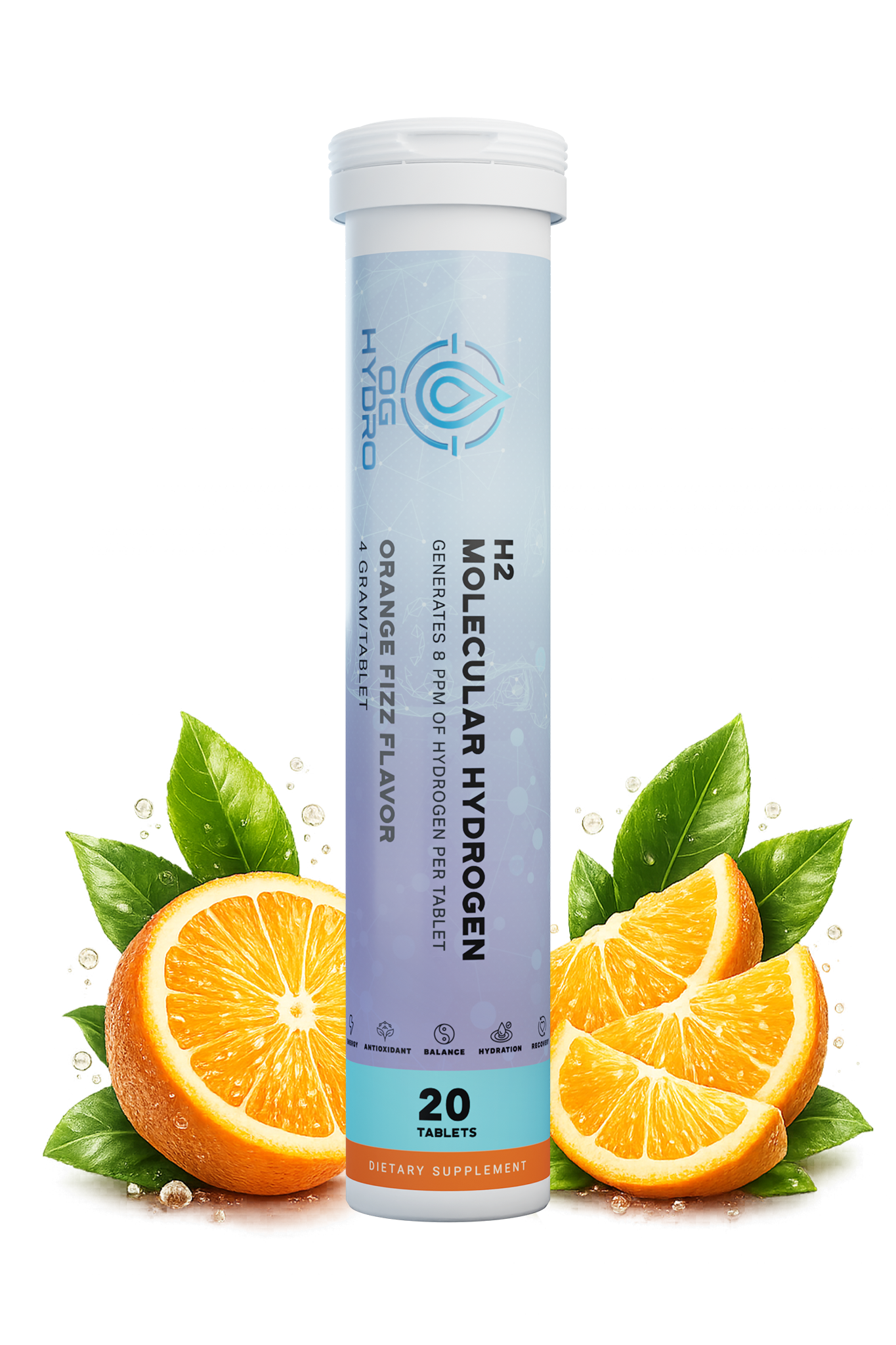
Drop one into any glass of water. Six flavours, zero sugar, zero caffeine.
- 8 ppmH₂ per tablet
- 20per tube
- 6flavours
At home
The OG Hydro Bottle
Brews fresh hydrogen water on demand with lab-grade electrolysis. Nothing to repurchase.
- 5 ppmpeak per brew
- −500 mVantioxidant ORP
- 18–25uses per charge
