


Is molecular hydrogen safe to drink?
What the FDA notice actually says, what a toxicology study tested, and where the evidence still has gaps.
- Study typeToxicology study
- Who took partBacteria, cells + rats
- How long28 days (rats)
The short version
- 01In 2014 the FDA said it had “no questions” about a company's conclusion that hydrogen gas is safe to add to drinks. That is a notice, not an approval.
- 02A 2010 toxicology study found no mutations, no chromosome damage and no harmful effects in rats given hydrogen-rich water for 28 days.
- 03Human trials have reported few side effects, mostly mild stomach upsets, but long-term data and data for pregnancy and children are missing.
Hydrogen isn't new to your body
Your gut bacteria make hydrogen every day as they break down food. A 1992 study measured about 35 mL of hydrogen a day leaving the body on a diet with no starch or fibre, and several times more after a fermentable sugar. Gut microbes also use up a lot of it.
Dissolved in water, hydrogen is stable and not flammable, as the FDA letter below notes. Flammability is a concern for cylinders of hydrogen gas, not for a drink.
What the FDA notice means
In 2014 a beverage company, MitoGene, notified the FDA that it considered hydrogen gas “generally recognized as safe” (GRAS) as an ingredient in drinking water, flavoured drinks and sodas, up to 2.14% by volume, the saturation level. It estimated that someone drinking 2 litres a day would take in about 3.2 mg of hydrogen. This is GRAS notice GRN 520.
On 28 November 2014 the FDA replied that it had “no questions”. That wording matters. The FDA's letter states that it has not made its own determination about the GRAS status, and that safety remains the company's responsibility. It is not an approval, and it says nothing about any health claim.
What the researchers tested
A Japanese team ran three standard toxicology tests on neutral-pH electrolysed hydrogen water containing about 0.9–1.1 ppm of hydrogen.
First, an Ames test, which checks whether something causes mutations in bacteria, using five bacterial strains, with and without liver enzymes. Second, a chromosome test in hamster lung cells. Third, rats were given 20 mL of the water per kg of body weight every day for 28 days. Their weight, blood, urine, organs and tissues were then checked.
The study
Toxicology and Industrial Health 26(4):203–216 · 2010
Saitoh Y, Harata Y, Mizuhashi F, Nakajima M, Miwa N. Biological safety of neutral-pH hydrogen-enriched electrolyzed water upon mutagenicity, genotoxicity and subchronic oral toxicity.
Read the original paperDOI 10.1177/0748233710362989
What they found
There were no mutations in any bacterial strain and no chromosome damage in the cells. The rats showed no treatment-related changes in behaviour, weight, food intake, blood, urine, organ weights or tissue under the microscope.
The highest dose tested was the “no observed adverse effect” level. The authors say this is consistent with a 60 kg adult safely drinking up to at least 1.2 litres a day.
Ames test
5 bacterial strains
No mutations
Chromosome test
Hamster lung cells
No damage
Rats, 28 days
20 mL/kg every day
No adverse effects
FDA GRN 520
Hydrogen in drinks, 2014
“No questions”
Human trials
Reviews + an 8-week trial
Mild stomach effects in a few
Long term, pregnancy, children
Little or no research
Not yet studied
“No questions” means the FDA didn't challenge the company's safety conclusion. It is not an approval.
What human studies add
A 2015 review of 321 hydrogen studies reported no toxic effects to the authors' knowledge, while noting there may be effects not yet found. A 2024 systematic review described hydrogen-rich water as “mostly considered safe, with no to minimal side effects”, and called for bigger, longer trials.
In one 8-week trial where 20 adults drank 1.5–2 litres a day, made with a magnesium stick, there were a few mild events possibly related to it: loose stools in three people, plus one case each of more frequent bowel movements, heartburn and headache. The magnesium may play a part. If your hydrogen comes from magnesium tablets, the magnesium counts toward the 350 mg a day upper limit the US National Institutes of Health sets for supplemental magnesium in adults, so check the label.
At the extreme end, commercial deep-sea divers in the 1990s breathed gas mixes containing about 49% hydrogen at huge pressures. The problems seen there were the effects of breathing dense gas at depth, not poisoning, and it's far beyond anything in a glass of water.
What this study doesn’t show
- It tested one electrolysed water in bacteria, cells and rats, not in people.
- The rat study lasted 28 days, so it can't speak to drinking it every day for years.
- There is little or no research for pregnancy, breastfeeding or children. Ask your doctor first.
The bottom line
So far the evidence points to hydrogen water being low-risk: your body already makes hydrogen, toxicology tests found nothing, and side effects in trials were mild. Low-risk so far isn't the same as fully studied, especially over the long term.
Sources
- [1]Saitoh Y, Harata Y, Mizuhashi F, Nakajima M, Miwa N. Biological safety of neutral-pH hydrogen-enriched electrolyzed water upon mutagenicity, genotoxicity and subchronic oral toxicity.Toxicology and Industrial Health 26(4):203–216, 2010
- [2]U.S. Food and Drug Administration. GRAS Notice No. 520: Hydrogen gas (MitoGene Beverage Company). Response: FDA has no questions.GRAS Notice Inventory, closed 28 November 2014
- [3]U.S. Food and Drug Administration. About the GRAS Notification Program.fda.gov
- [4]Nakao A, Toyoda Y, Sharma P, Evans M, Guthrie N. Effectiveness of hydrogen rich water on antioxidant status of subjects with potential metabolic syndrome: an open label pilot study.Journal of Clinical Biochemistry and Nutrition 46(2):140–149, 2010
- [5]Ichihara M, et al. Beneficial biological effects and the underlying mechanisms of molecular hydrogen: comprehensive review of 321 original articles.Medical Gas Research 5:12, 2015
- [6]Dhillon G, et al. Hydrogen Water: Extra Healthy or a Hoax? A Systematic Review.International Journal of Molecular Sciences 25(2):973, 2024
- [7]Abraini JH, Gardette-Chauffour MC, Martinez E, Rostain JC, Lemaire C. Psychophysiological reactions in humans during an open sea dive to 500 m with a hydrogen-helium-oxygen mixture.Journal of Applied Physiology 76(3):1113–1118, 1994
- [8]Christl SU, Murgatroyd PR, Gibson GR, Cummings JH. Production, metabolism, and excretion of hydrogen in the large intestine.Gastroenterology 102(4 Pt 1):1269–1277, 1992
- [9]NIH Office of Dietary Supplements. Magnesium: Fact Sheet for Health Professionals.ods.od.nih.gov
This article is an educational summary of published research on molecular hydrogen. It is not medical advice, and these statements have not been evaluated by the Food and Drug Administration. OG Hydro products are not intended to diagnose, treat, cure, or prevent any disease. Talk to a qualified healthcare professional before changing your routine.
Keep reading
More from the research library
How it works · 5 min read
How a bottle makes hydrogen water
What actually happens when you press the button, what the thin membrane inside is for, and what a 2021 lab test found in the water afterwards.
Read the article
Freshness · 6 min read
How long hydrogen stays in water
Hydrogen is the smallest molecule there is, and it doesn't stay put. Japan's consumer agency measured how fast it leaves, and what a “ppm” number really tells you.
Read the article
Oxidative stress · 5 min read
Hydrogen as a selective antioxidant
The 2007 paper that put molecular hydrogen on the research map, and why the word “selective” matters.
Read the articleFrom the research to your glass
Two ways to drink it.
On the go
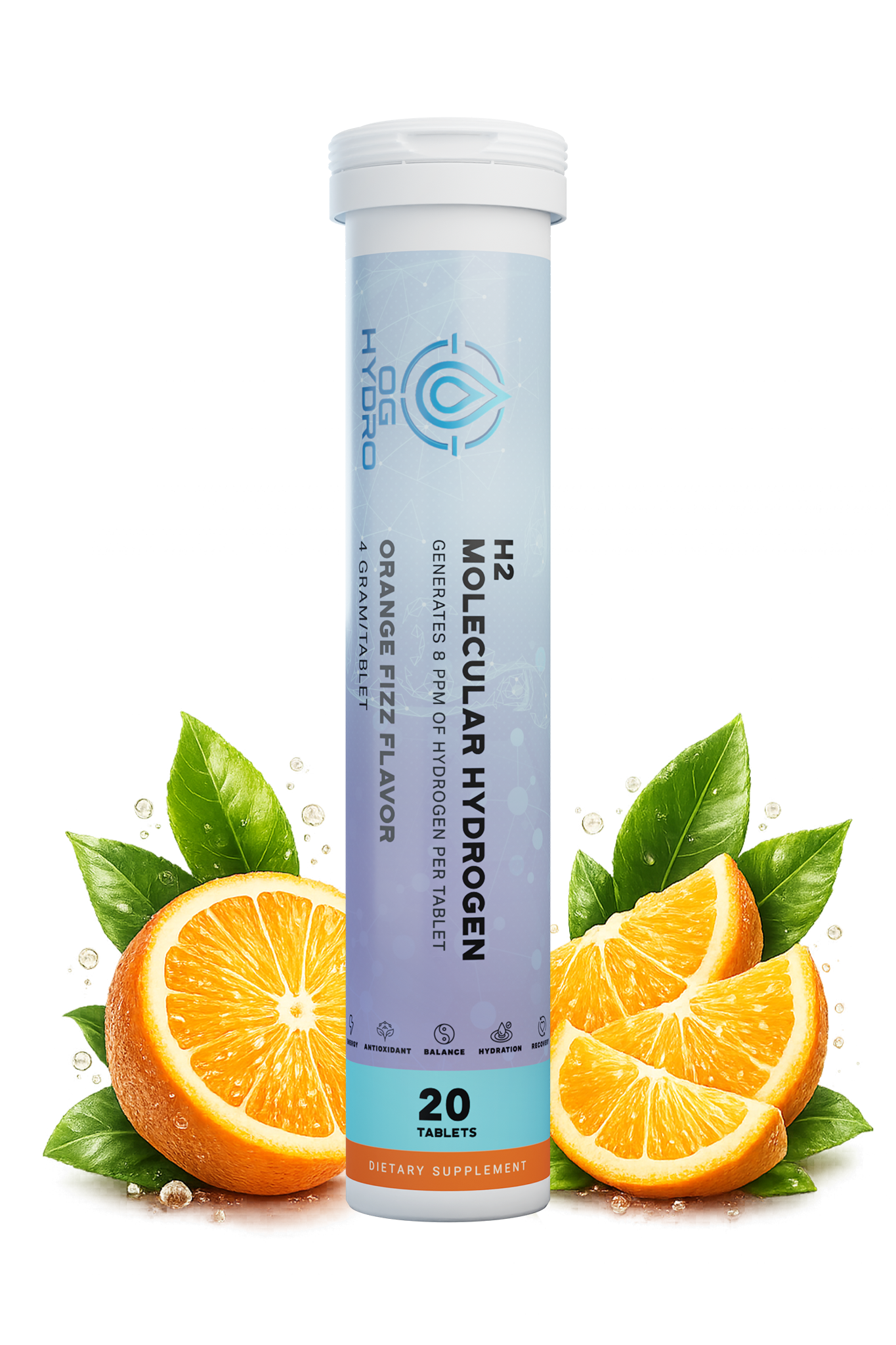
Hydrogen Tablets
Drop one into any glass of water. Six flavours, zero sugar, zero caffeine.
- 8 ppmH₂ per tablet
- 20per tube
- 6flavours
At home
The OG Hydro Bottle
Brews fresh hydrogen water on demand with lab-grade electrolysis. Nothing to repurchase.
- 5 ppmpeak per brew
- −500 mVantioxidant ORP
- 18–25uses per charge
