


How a bottle makes hydrogen water
What actually happens when you press the button, what the thin membrane inside is for, and what a 2021 lab test found in the water afterwards.
- Study typeLab measurement
- Who took part1 portable bottle, tap water
- How long10 and 30 min runs
The short version
- 01Electrolysis uses a small electric current to split water: hydrogen forms at one electrode, oxygen at the other.
- 02In a PEM (proton exchange membrane) design, a thin membrane between the electrodes keeps the hydrogen side and the oxygen side apart.
- 03A 2021 lab test of a portable bottle found chlorine went down and ozone stayed undetectable after brewing, within drinking-water safety limits.
Splitting water with electricity
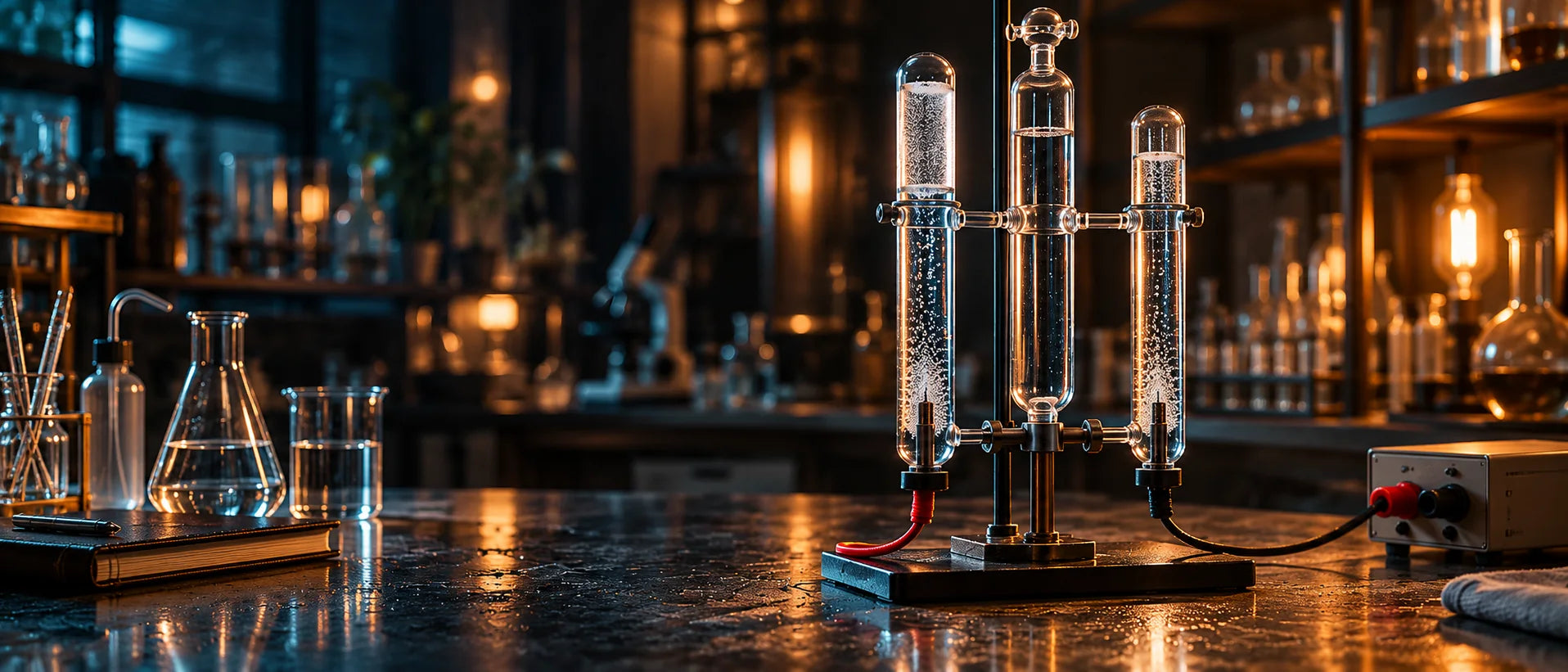
Water is H₂O: two hydrogen atoms and one oxygen atom. Pass a small electric current through it between two electrodes and it splits. At the positive electrode (the anode), water gives up oxygen gas and hydrogen ions, which are simply protons. At the negative electrode (the cathode), those protons pick up electrons and pair up as hydrogen gas, H₂.
That dissolved H₂ is the whole point. A 2022 review of decades of research on electrolysed water concluded that molecular hydrogen is the ingredient behind the effects reported in studies, not alkalinity, “micro-clusters” or the other explanations that used to be suggested.
What the membrane is for
In a PEM cell, also called SPE (solid polymer electrolyte), a thin sheet of special polymer sits between the two electrodes. It lets protons pass through but keeps the gases on their own sides: oxygen at the anode, hydrogen at the cathode.
Industrial hydrogen plants use the same idea at a much bigger scale. A 2025 review in Chemical Reviews describes the membrane's job as keeping oxygen on the anode side and hydrogen on the cathode side, and notes that perfluorosulfonic acid (PFSA) membranes, the family Nafion belongs to, allow hydrogen of up to 99.999% purity. The same review describes titanium parts coated with platinum or gold as standard, because they survive the harsh conditions at the electrodes.
What the researchers measured
Tap water contains chloride and a little chlorine, which is added to keep it safe. At the anode, electrolysis can turn chloride into chlorine compounds and, under some conditions, form ozone. That raises a fair question: what else ends up in the water from a hydrogen bottle?
Two researchers in Japan tested a portable hydrogen bottle with platinum-plated electrodes, filled with Osaka city tap water. They ran it for 10 and 30 minutes, then measured hydrogen, free and combined chlorine, and ozone using several different methods.
The study
Medical Gas Research 11(2):61–65 · 2021
Hatae T, Miwa N. Electrolytic hydrogen-generating bottle supplies drinking water with free/combined chlorine and ozone repressed within safety standard under hydrogen-rich conditions.
Read the original paperDOI 10.4103/2045-9912.311496
What they found
Chlorine went down, not up: free chlorine fell from 0.18 to 0.12 mg/L after 10 minutes, far below the World Health Organization's guideline of 5 mg/L. Ozone was below the detection limit (under 0.05 mg/L) with every method, under the 0.1 mg/L standard used in Japan and the US.
Dissolved hydrogen reached about 444 µg/L (around 0.44 ppm) after 10 minutes and about 479 µg/L after 30 minutes.
One detail matters here: the bottle they tested had no membrane between its electrodes. So the study shows that a well-designed bottle can stay within safety limits even without one. A PEM design adds a physical barrier on top, keeping whatever forms at the anode on the other side of the membrane by design.
Anode (+)
Oxygen side
2H₂O → O₂ + 4H⁺ + 4e⁻
Water splits. Oxygen and anything else that forms here stay on this side.
Membrane (PEM)
H⁺ →
Lets protons through, keeps the two gases apart
Cathode (−)
Hydrogen side
4H⁺ + 4e⁻ → 2H₂
Protons pick up electrons and pair up as H₂, which dissolves into the water.
Chlorine in the water went down, not up, and ozone stayed below what any of the tests could detect.
Why the design still matters
What ends up in the glass depends on the whole design: the electrodes, how long it runs, the water you put in and how the two sides are separated. No published study has yet compared bottles with and without a membrane head to head, so it's fairest to say the membrane is a sound engineering choice rather than something research has proven makes a difference to you.
What this study doesn’t show
- It tested one bottle model in one city's tap water.
- That bottle had no membrane, so its results can't be read straight across to PEM designs, and no study has compared the two head to head.
- It measured water chemistry, not any effect on the people drinking it.
The bottom line
Electrolysis is a simple idea: electricity splits water, hydrogen forms on one side and oxygen on the other. A membrane keeps the two sides apart by design, and a 2021 lab test found a portable bottle kept chlorine and ozone within drinking-water limits.
Sources
- [1]Hatae T, Miwa N. Electrolytic hydrogen-generating bottle supplies drinking water with free/combined chlorine and ozone repressed within safety standard under hydrogen-rich conditions.Medical Gas Research 11(2):61–65, 2021
- [2]Wang CR, Stansberry JM, Mukundan R, et al. Proton Exchange Membrane (PEM) Water Electrolysis: Cell-Level Considerations for Gigawatt-Scale Deployment.Chemical Reviews 125(3):1257–1302, 2025
- [3]LeBaron TW, Sharpe R, Ohno K. Electrolyzed-Reduced Water: Review I. Molecular Hydrogen Is the Exclusive Agent Responsible for the Therapeutic Effects.International Journal of Molecular Sciences 23(23):14750, 2022
- [4]LeBaron TW, Sharpe R, Ohno K. Electrolyzed-Reduced Water: Review II: Safety Concerns and Effectiveness as a Source of Hydrogen Water.International Journal of Molecular Sciences 23(23):14508, 2022
This article is an educational summary of published research on molecular hydrogen. It is not medical advice, and these statements have not been evaluated by the Food and Drug Administration. OG Hydro products are not intended to diagnose, treat, cure, or prevent any disease. Talk to a qualified healthcare professional before changing your routine.
Keep reading
More from the research library
Freshness · 6 min read
How long hydrogen stays in water
Hydrogen is the smallest molecule there is, and it doesn't stay put. Japan's consumer agency measured how fast it leaves, and what a “ppm” number really tells you.
Read the article
Safety · 6 min read
Is molecular hydrogen safe to drink?
What the FDA notice actually says, what a toxicology study tested, and where the evidence still has gaps.
Read the article
Oxidative stress · 5 min read
Hydrogen as a selective antioxidant
The 2007 paper that put molecular hydrogen on the research map, and why the word “selective” matters.
Read the articleFrom the research to your glass
Two ways to drink it.
On the go
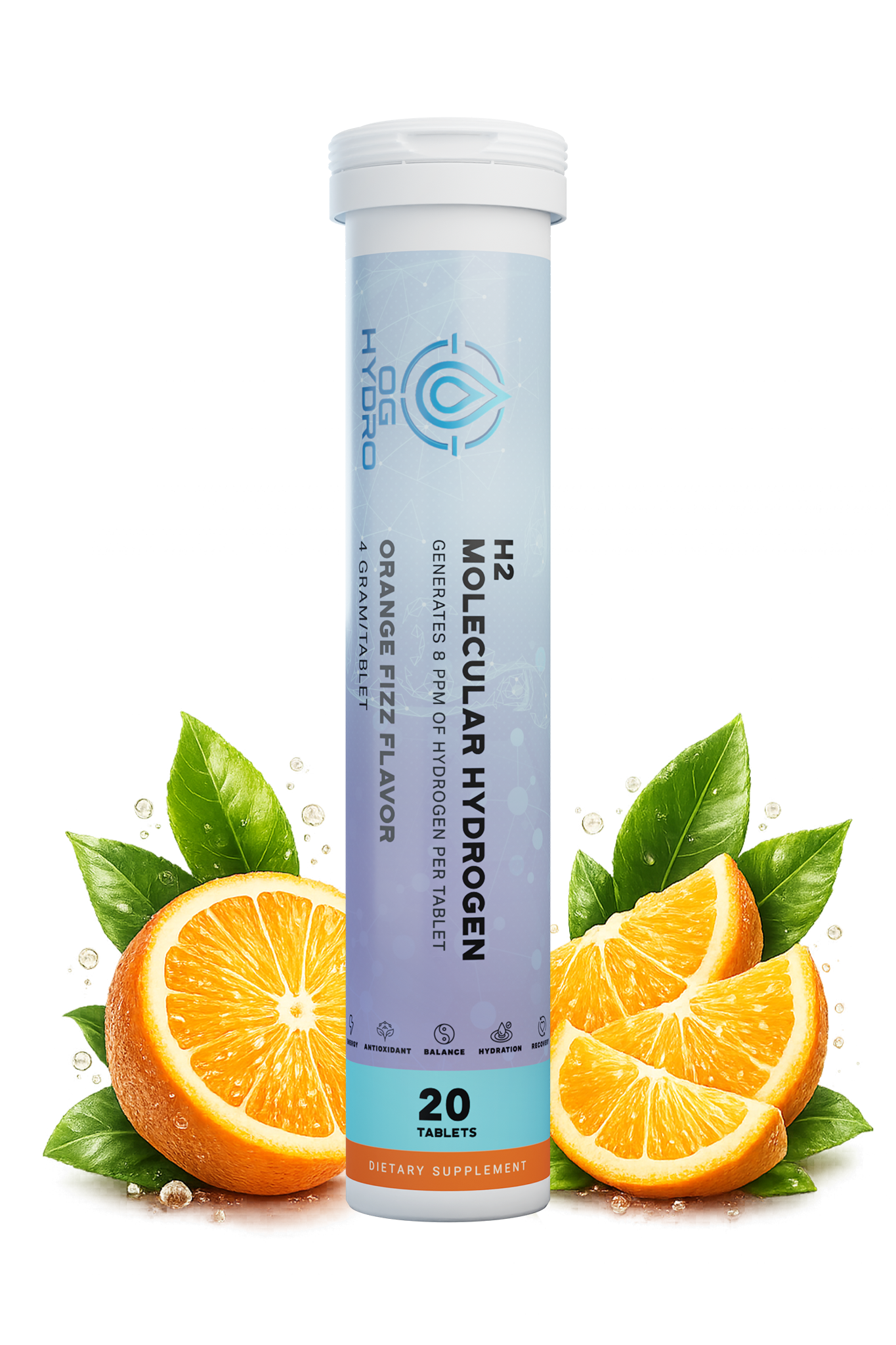
Hydrogen Tablets
Drop one into any glass of water. Six flavours, zero sugar, zero caffeine.
- 8 ppmH₂ per tablet
- 20per tube
- 6flavours
At home
The OG Hydro Bottle
Brews fresh hydrogen water on demand with lab-grade electrolysis. Nothing to repurchase.
- 5 ppmpeak per brew
- −500 mVantioxidant ORP
- 18–25uses per charge
